
Pentagon AI Use in War Raises Questions on Legal Limits and Accountability
AI has moved from support tools in defense operations to a central part of how modern warfare is conducted. In the ongoing Iran conflict, the U.S. military has leaned on advanced data systems more heavily than in any previous war.
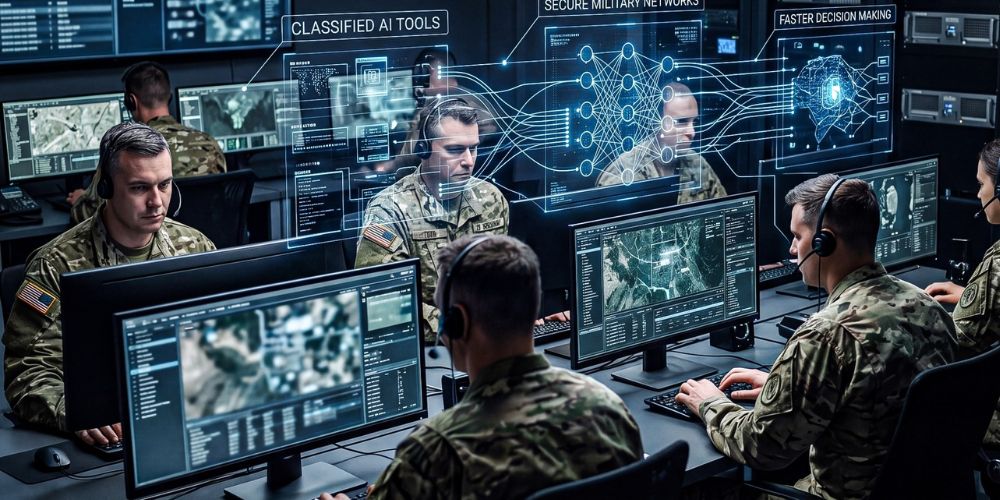
Satellite feeds, signals intelligence, and field reports now flow into AI-driven platforms built by defense contractors such as Palantir. These systems process vast volumes of information in seconds, shaping how commanders identify and evaluate potential targets.
Tools powered by models like Anthropic’s Claude have been used to scan intelligence faster than human teams, flagging possible strike targets within complex data streams. While this speed has changed battlefield operations, it has also sparked concern about accuracy, accountability, and civilian harm.
Questions now circle around how far AI can go in the military decision chain, especially when legal responsibility still rests with human commanders.
AI Expansion in Modern Combat

Instagram | petehegseth | Defense Secretary Hegseth clarified that human authority remains the final word in AI warfare.
The Iran war has become a defining moment for AI integration in military operations. Data once reviewed manually by analysts is now filtered through automated systems that prioritize, sort, and highlight potential threats. These tools reduce the time needed to process intelligence, but they also compress decision-making cycles.
A reported U.S. strike in February that hit an Iranian elementary school, with Iranian state media stating at least 168 children were killed, intensified scrutiny. Lawmakers questioned whether AI-assisted analysis played a role in the targeting chain. The Pentagon has opened an investigation into the incident, though a direct link to AI use has not been confirmed.
Defense Secretary Pete Hegseth has maintained that human authority remains central. He told the Senate Armed Services Committee, “We follow the law and humans make decisions. AI is not making lethal decisions.”
Legal Responsibility and Kill Chain
Military law has not been rewritten to match the pace of AI development. Instead, existing rules under the law of armed conflict and international humanitarian law continue to apply. Commanders remain accountable for minimizing civilian harm and ensuring lawful targeting decisions.
Inside the so-called “kill chain,” AI tools may assist with detection and assessment, but they do not hold legal authority. Responsibility remains with officers and legal advisers embedded in military units.
Pentagon guidance issued in 2023 states that autonomous systems must allow “appropriate levels of human judgment over the use of force.” A similar phrase appeared in earlier 2020 guidance during the first Trump administration. The language leaves interpretation open, particularly around what qualifies as “appropriate” involvement.
A Pentagon spokesperson has reiterated that a human operator is always involved in any autonomous capability and that legal responsibility sits with the chain of command, not the software itself.
Speed and the OODA Loop Pressure
Modern warfare increasingly revolves around decision speed. The military concept known as the OODA loop—observe, orient, decide, act—was developed by U.S. Air Force Colonel John Boyd to describe how commanders process battlefield information.
Former legal adviser to U.S. Special Operations Command Cory Simpson explained that AI compresses this cycle dramatically. Faster data processing shortens the time available for review, increasing pressure on human oversight.
Former deputy legal counsel in the Office of the Chairman of the Joint Chiefs of Staff Gary Corn described the situation with a blunt comparison, noting the challenge is “how fast you choose to — or can afford not to — run with scissors.” He added that current practice reflects a push to operate at maximum speed, even while risks remain unresolved.
Palantir Systems and Battlefield Data Flow
AI-driven targeting systems now sit at the center of U.S. defense operations. In a March video posted on X by Palantir, the Pentagon’s chief digital and AI officer Cameron Stanley showcased the Maven Smart System.
Stanley described how the platform consolidates data from multiple sources and moves potential targets into a structured workflow for commanders. He noted that earlier systems required manual coordination across several platforms before reaching a decision point.
“This is revolutionary,” Stanley said. “We were having this done in about eight or nine systems, where humans were literally moving detections left and right in order to get to our desired end state, in this case, actually closing a kill chain.”
The system is now deployed across the Department of Defense, streamlining how intelligence moves from detection to decision.
Civilian Risk and System Limits

Instagram | realnewsnobullshit | Military strategist Erik Kurilla notes that AI-driven data processing has revolutionized targeting speed.
AI systems can be trained to reduce civilian harm, but they cannot fully interpret moral thresholds in warfare. Experts warn that responsibility for proportionality and judgment cannot be transferred to algorithms.
Concerns grow sharper when systems operate at scale and speed. The risk is not only misidentification but also overreliance on automated recommendations that may lack full context.
Military strategist Michael “Erik” Kurilla, who oversaw recent U.S. operations in the region, described how AI changes targeting capacity. He explained that modern systems can process “tens of thousands and hundreds of thousands of data points” into actionable intelligence, allowing commanders to act at unprecedented speed.
He also noted that increased capability brings a parallel need for human review at every stage.
Policy Tension and Industry Disputes
The Pentagon’s relationship with AI developers has also become strained. A legal dispute involving Anthropic highlights disagreements over how military customers should use advanced models.
Company leadership pushed for restrictions on deployment in certain contexts, a position that drew sharp criticism from Defense Secretary Hegseth, who referred to Anthropic’s CEO as an “ideological lunatic.”
The disagreement reflects a broader divide between rapid military adoption and caution from parts of the tech industry.
AI now plays a central role in how military intelligence is processed, filtered, and acted upon. Yet the legal structure guiding its use still rests on human accountability, not machine authority. Existing law places responsibility for every strike decision on commanders, even as AI compresses the time available for judgment.
The gap between technological speed and legal clarity continues to widen. As systems like those built by Palantir expand across defense operations, the question remains less about whether AI will be used, and more about how far human oversight can realistically stretch within shrinking decision windows.
More in Law Degree
-
 Brooklyn Beckham’s Billionaire Father-in-Law Breaks Silence on the Family Feud
The Beckham family drama just took another sharp turn. This time, the voice cutting through the noise belongs to billionaire investor...
February 22, 2026 -
 Notre Dame Faces Faculty Resigns After Controversial Appointment
Tension is rising at the University of Notre Dame after two scholars cut formal ties with the Liu Institute for Asia...
February 22, 2026 -
 High Court Upholds Malay Celeb Preacher Da’i Syed’s Rape Conviction
The Shah Alam High Court has spoken, and it spoke clearly. Celebrity preacher Da’i Syed will go to prison now, not...
February 15, 2026 -
 Venezuela Opens Oil Industry as U.S. Threatens Cuba Tariffs
Venezuela has passed a significant law change aimed at opening its oil industry to foreign investment. The move, endorsed by acting...
February 15, 2026 -
 Is a ChatGPT-Written Will Legal?
At first glance, using AI to draft a will seems like a smart idea. It’s fast, free, and has a modern...
February 6, 2026 -
 Prince Harry Supports Elizabeth Hurley in Tabloid Privacy Case
London’s High Court became the center of attention as Prince Harry appeared in support of Elizabeth Hurley during an emotional hearing...
February 6, 2026 -
 5 Ways AI Is Transforming Daily Legal Workflows
AI did not storm into law firms with fireworks. It slipped in through contracts, research tabs, inboxes, and meeting notes. By...
February 1, 2026 -
 How to Legally Protect Your Side Hustle Without Spending a Fortune
Starting a side hustle is a practical way to test a business idea, generate extra income, or lay the foundation for...
February 1, 2026 -
 Mayor Zohran Mamdani Appoints Christine Clarke as Human Rights Chair
On January 7, 2026, during his first full week in office, Zohran Mamdani made a move that set the tone for...
January 25, 2026
More From Lawyers Favorite
-
 Criminal AttorneyUS Supreme Court Limits Sentence Reductions for Federal Prisoners
The U.S. Supreme Court has issued a major ruling that reshapes how far prison reform laws can reach into past sentencing....
June 12, 2026 -
 Celeb JusticeInside Ex-Prince Andrew’s “Bleak” Life in Exile as New Claims Emerge
Once positioned near the center of Britain’s royal institution, Andrew Mountbatten-Windsor now faces a reality far removed from palace ceremonies and...
June 6, 2026 -
 Legal AdviceU.S. Lawmakers Push Bill to Expand Burn Pit Benefits to Civilian Workers
A bipartisan group of U.S. lawmakers has introduced a draft proposal aimed at expanding workers’ compensation access for civilian federal employees...
May 30, 2026 -
 Law DegreePentagon AI Use in War Raises Questions on Legal Limits and Accountability
AI has moved from support tools in defense operations to a central part of how modern warfare is conducted. In the...
May 22, 2026 -
 Criminal AttorneyIdaho Bathroom Law Faces Federal Lawsuit by Transgender Residents
A new Idaho law restricting restroom access has triggered a federal court challenge from transgender residents who say it places daily...
May 15, 2026